As conventional agricultural practices reach their limits, humanity is turning to innovative methods of food production. Using Heather Paxson’s concept of microbiopolitics (2012) as a framework that highlights how microbial life is integrated into social governance, particularly in food production and safety, this article explores the role of microbes in cultivated meat and aquaponic farming.
It is impossible to replicate completely the heterogeneity of soil ecosystems without soil itself. The intricate soil associations found in open-ended ecosystems are usually reduced to amplify plant growth in the aquaponic indoor environment.
It examines how researchers and producers engage with microbes and considers the potential scenarios of human-microbial coexistence in these systems. First, drawing on ethnographic research in Czechia, the article investigates the role of microbes in production processes within the environments of bioreactors and indoor farms. The analysis highlights the contrast between the sterility of cultivated meat facilities and aquaponic systems, which depend on the labor of specific microbes.
Second, using speculative fabulation (Haraway 2016), the article explores the broader implications of aquaponics production for microbial communities beyond the production process. Building upon the two-way dynamics of reduction and amplification (Latour 1999), where diminishing one quality is necessary to enhance other attributes, the article examines possible impacts of these novel foods on the environmental and gut microbiomes.
Regarding aquaponic systems, we identify a potential reduction in the microbial diversity in the human diet produced by way of aquaponics, while the transparency of microbial community structures within aquaponic facilities and the soil microbiome outside these farms may be amplified.
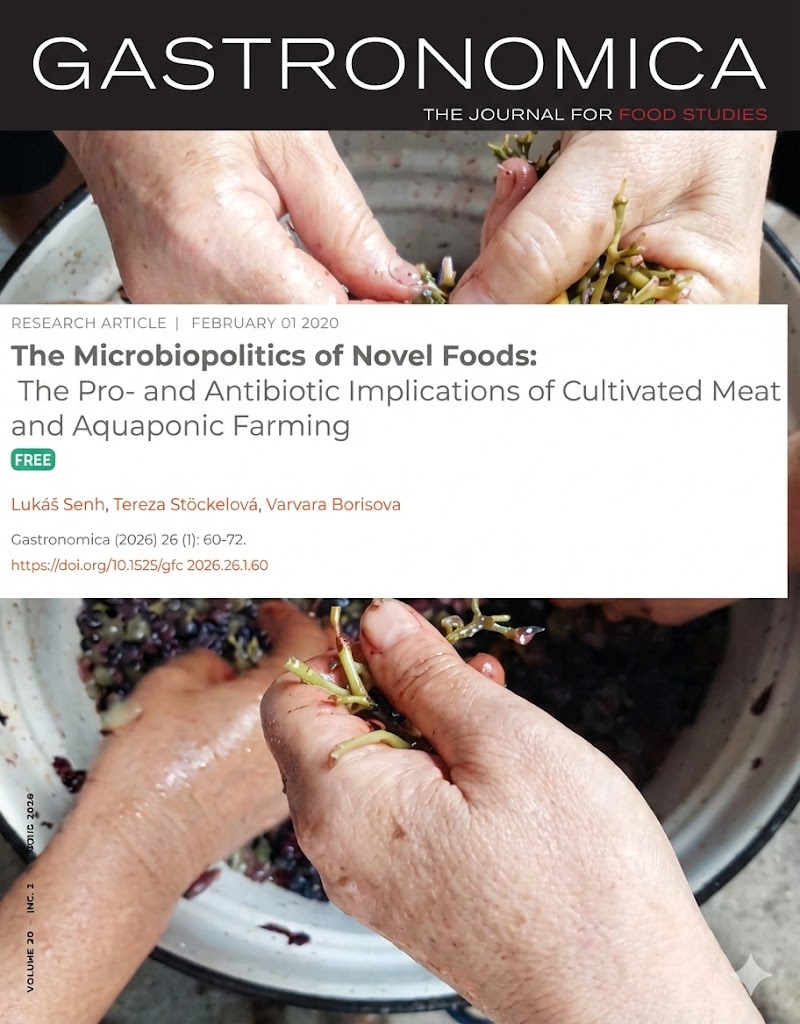
Source: Senft, Lukáš, Tereza Stöckelová, and Varvara Borisova. “The Microbiopolitics of Novel Foods: The Pro-and Antibiotic Implications of Cultivated Meat and Aquaponic Farming.” Gastronomica: The Journal of Food and Culture 26.1 (2026): 60-72.